| Managing Repository Content |

|
|
|
|
| Using Schemas to Customize Metadata > About DCLs and Metadata Schemas > Schema Hierarchical Structure | |
| Managing Repository Content |
|
|
|
|
| Using Schemas to Customize Metadata > About DCLs and Metadata Schemas > Schema Hierarchical Structure | |
A schema is a collection of related schema objects. The term schema also refers to a graphical depiction of the database hierarchy that is created to support the Content Server metadata schema mapping feature. The schema hierarchical structure consists of tables and their respective columns (or fields), views of the data, and the relationships between them.
The Country and State example can be continued to more fully describe a schema hierarchy. Additional information fields (City, Region, and Area Code) are included to illustrate a three-tiered dependency structure.
In Figure 7-1, the sample basic schema hierarchy, one independent field has two dependent fields. Each dependent field also has a dependent field. These dependencies are also referred to as Parent/Child relationships.
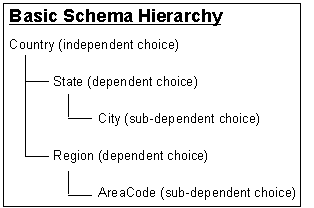
This three-level schema hierarchy produces five distinct metadata fields: Country, State, City, Region, and Area Code. Each field presents a specific option list to the user.
The contents of the option lists are contingent on whether the information field is dependent or not. Thus, the following option lists result from the sample basic Country/State/Zip schema hierarchy:
|
|
|
Copyright © 1996, 2007, Oracle. All rights reserved. |